


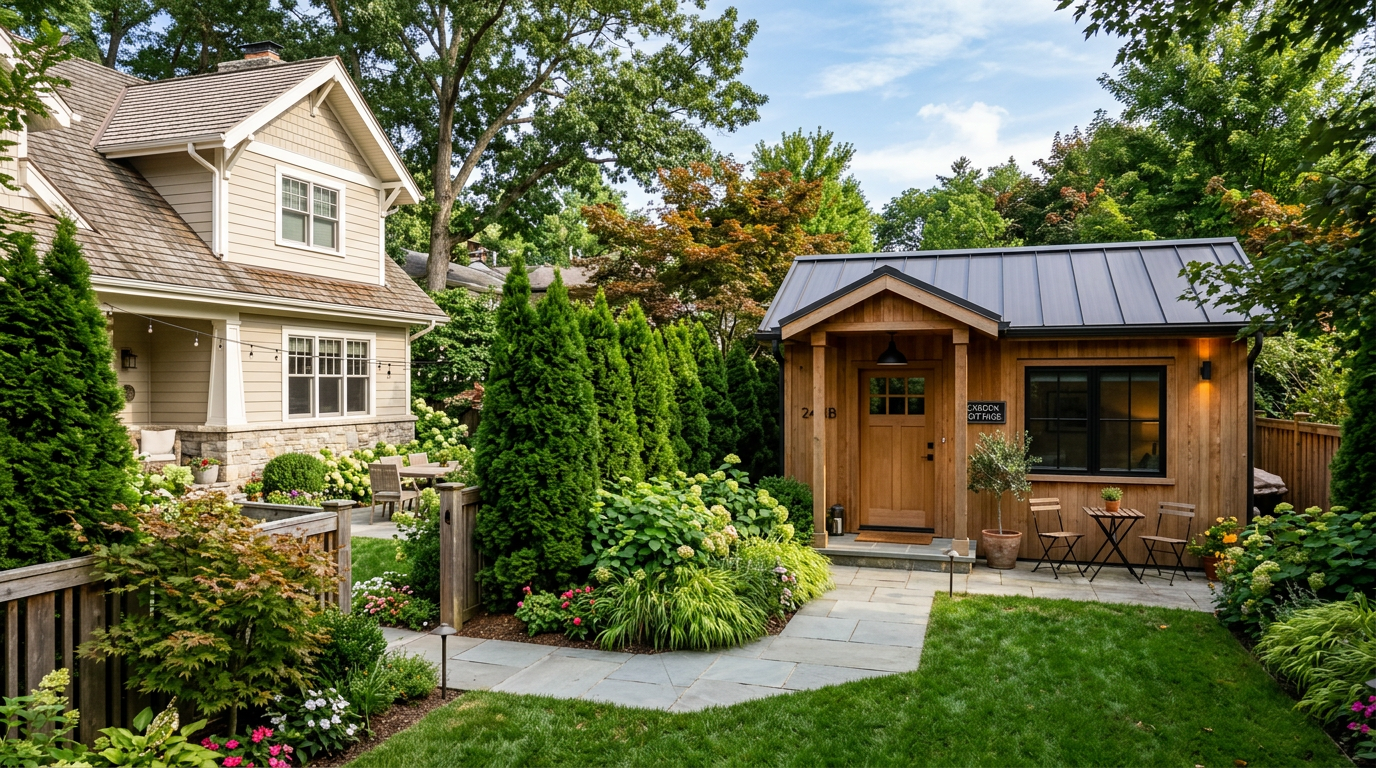
Deciding whether to invest in an Accessory Dwelling Unit (ADU) is a major capital allocation choice.Because ADUs combine real estate development, zoning compliance, and landlord responsibilities, you need to weigh upfront development costs against long-term cash flow and property appreciation.
To evaluate whether an ADU makes sense for your portfolio, let’s look at the core financial trade-offs, followed by an interactive model to simulate your potential rental income and return on investment.
Key Factors in the ADU Investment Decision
When deciding whether to build, evaluate these four pillars:
- Upfront Capital & Financing: ADUs require significant upfront capital—ranging from $150,000 to over $350,000+ depending on whether it is a detached custom build, a garage conversion, or a prefabricated unit. Financing often involves cash, home equity lines of credit (HELOCs), or construction loans.
- Rental Yield vs. Opportunity Cost: Calculate your expected monthly rental income against your total investment. Compare this yield to alternative investments (such as the stock market or paying down existing debt) with similar liquidity profiles.
- Property Tax Reassessment: In many jurisdictions, adding square footage triggers a reassessment of the new construction portion of the property, which increases your annual property tax baseline.
- Zoning & Feasibility Constraints: Local lot coverage limits, setbacks, parking requirements, and utility hookup fees can dramatically alter your total budget and construction timeline before you ever break ground.
Upfront Capital & Financing Tips
Choosing the best way to finance an Accessory Dwelling Unit (ADU) depends entirely on how much existing home equity you have and the interest rate on your current primary mortgage. Because ADU builds involve staged disbursements (paying contractors as milestones are met), the right loan vehicle prevents you from paying interest on a lump sum upfront.
The primary financing paths are compared below to help determine which structure fits your situation:
| Financing Option | Typical Rate (2026) | Best For | Key Advantage |
| HELOC (Home Equity Line of Credit) | 7.0% – 8.5% (variable) | Homeowners with strong existing equity | Flexible draw schedule; keeps your low existing mortgage rate untouched. |
| ADU-Specific Renovation Loan (e.g., RenoFi, HomeStyle) | 6.5% – 9.0% | Homeowners with lower current equity | Underwrites to your home’s future after-renovation value (ARV)rather than current equity. |
| Construction-to-Permanent Loan | 7.0% – 9.0% | Large detached builds or custom architectural projects | Funds construction in milestone draws, then converts into a single permanent mortgage. |
| Cash-Out Refinance | 6.5% – 7.5% | Homeowners whose current mortgage rate is already high | Simple single loan, but a poor choice if you currently hold a sub-5% fixed rate. |
Which Option Should You Choose?
- If you have ample home equity (and a low first-mortgage rate): A HELOC is typically the most efficient path. You only draw funds as construction invoices roll in, and you only pay interest on what you’ve actually drawn during the build phase.
- If you have limited current equity but strong credit: Look at specialized renovation loans (such as RenoFi or Fannie Mae HomeStyle). These look at the projected value of your property after the ADU is built, allowing you to borrow more without disrupting your primary mortgage.
- If you are building an investment property: A DSCR (Debt Service Coverage Ratio) loan lets you qualify based on the projected rental income of the ADU rather than your personal W-2 income.
The city of Sacramento provide a ADU budget calculator which one can always take advantage of it when budgeting.
https://adu.cityofsacramento.org/design/step-4/budget
Leave a Reply